
The Challenge
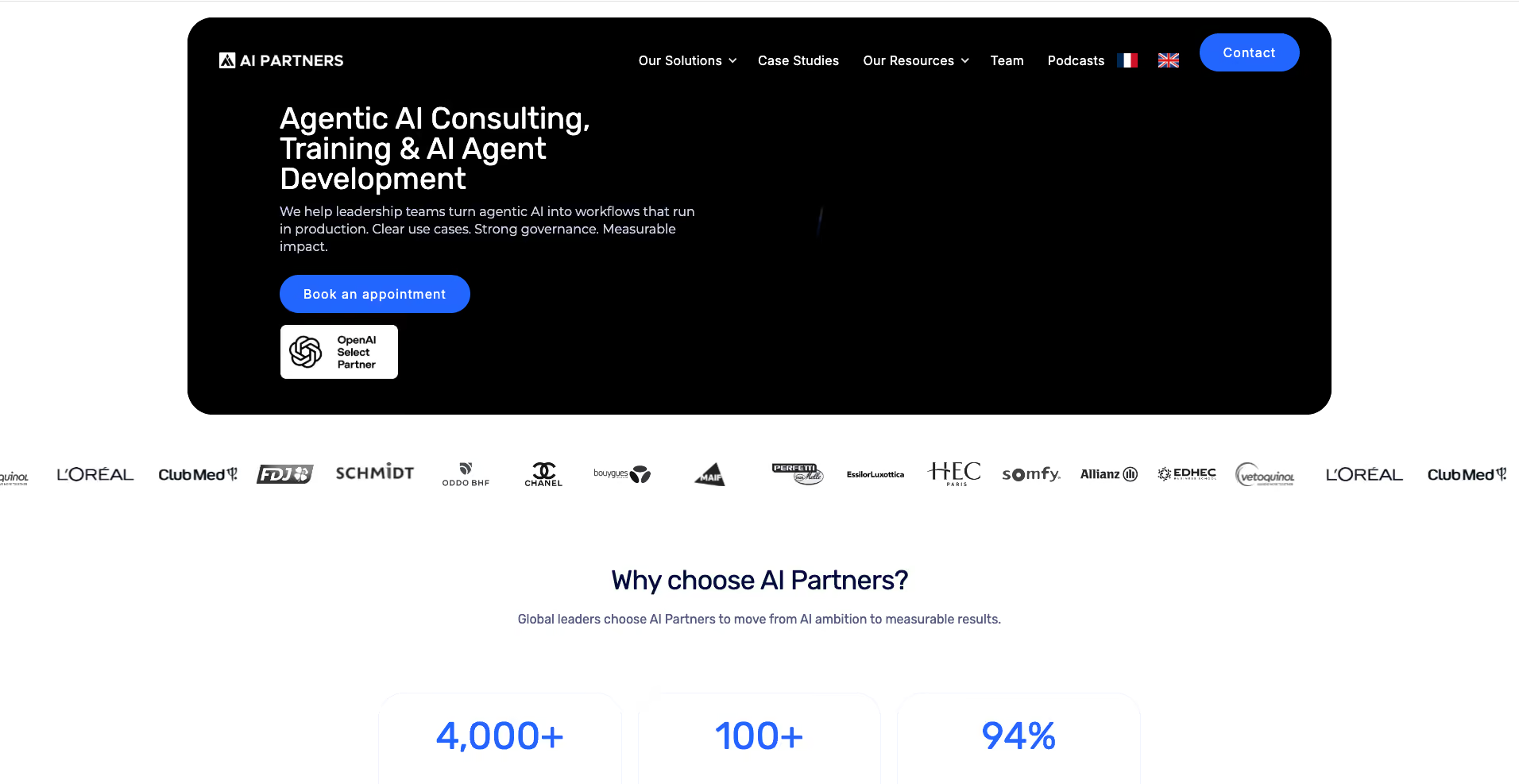
AI Partners set out to prove, in a single case-study format, that its own agentic AI consultancy could turn enterprise-scale AI ambition into production results. The firm works with large organizations, many with more than ten thousand employees, that need help moving past pilot projects and one-off experiments toward AI programs with clear governance, trained teams, and measurable business impact. The page needed to show three different kinds of proof at once: that teams can be trained, that a roadmap can be built, and that AI agents can actually ship into daily operations.
The Approach
The page is structured around AI Partners' own three-pillar model: AI Academy for training, AI First Organization for strategy and roadmapping, and AI Factory for building and deploying agents. Rather than describing agentic AI in the abstract, each pillar is paired with a named enterprise client and a concrete result, so a visitor evaluating the firm can see exactly what engaging AI Partners produces rather than taking a capability claim on faith.
Proving a Three-Pillar Offering
With training, strategy, and deployment work all under one roof, the risk was that visitors would see three disconnected services instead of one coherent partner. The page handles this by walking the same client, such as Schmidt Groupe, through more than one pillar at once - training a thousand employees, then shipping an AI sales assistant into stores - so the pillars read as stages of one program rather than three separate pitches.
Building Trust With Named Enterprise Results
Because agentic AI is still unfamiliar to many enterprise buyers, the page leans on specific, named outcomes rather than general claims: 12 AI agents built with L'Oreal in three days, 560 e-commerce pages generated for Perfetti Van Melle across 14 brands, and a 9% sales-conversion lift for Schmidt Groupe. Repeating real numbers tied to recognizable brands does more to build confidence than a generic capabilities list.